“Intersectionality” - Just Another Word that Erases Women
Another pregnancy study that fails to note that babies are humans too

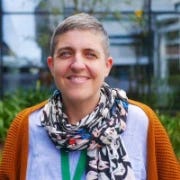
Dr. George Parker (that would be a PhD doctorate, not an MD) is a Senior Lecturer in Health Service Delivery at a university in New Zealand. She is a woman but identifies as “a nonbinary trans person” (whatever that is) and you will not be surprised to learn specializes in health delivery to trans/queer/flavor of the month people because as everyone knows, they are Marginalized and Not Catered To, in the manner that they apparently feel they should be. All of her work available to the public is on some aspect of trans care.
One of her recently published papers, where she is the lead author is entitled, “Let All Identities Bloom, Just Let Them Bloom”: Advancing Trans-Inclusive Perinatal Care Through Intersectional Analysis.
Perinatal care is defined as healthcare services provided to women and infants during the period from conception through the first year after birth. It includes both prenatal (before birth) and postnatal (after birth) care, addressing the health of both the mother and the infant. It does not include men, fathers or any other type of non-gestational parent.
This has not stopped Parker from including some “non-gestational parents” in her analysis.
What is “intersectionality” and how does it change the rankings of the oppressed minorities?
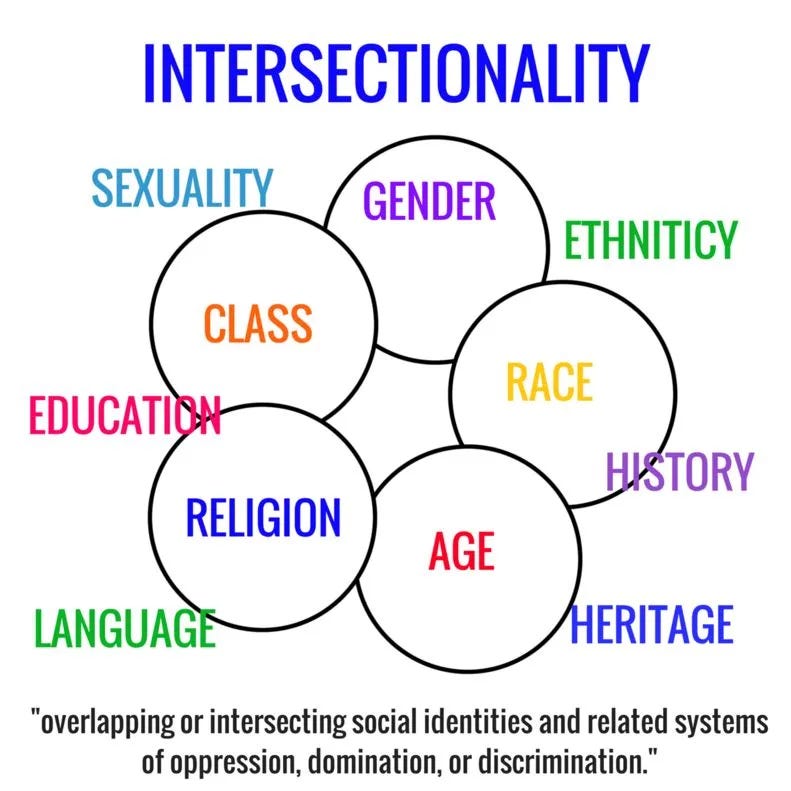
Intersectionality is defined as the interconnected nature of social categorizations such as race, class, religion and gender as they apply to a given individual or group, regarded as creating overlapping and interdependent systems of discrimination or disadvantage.
In simple terms this means that people get more “points” if they can fit into more categories. In practice that means that white, straight men get no points at all as they are considered to be the most privileged sector of society, while a trans/queer fat woman who needs to use a wheelchair will win most of the time.
Intersectionality forms an unholy marriage with gender and identity politics. When they merge with intersectionality they create two narrow prisms: villainy and victimhood. This is where the concept of privilege also comes into play. People are graded on the spectrum of villainy and victimhood based on social identities.
This has created what some have called the “Oppression Olympics”; it does not actually look at real people or account for differing circumstances. In true Gladiator style it pits people against each other while assuming that “identities” outrank reality.
Which is one reason why pregnant women are reduced to pregnant “people” or “birthing people” or any other term that denies the biological reality that only female mammals can become pregnant and produce new members of their species.
“I’m not safe to be my whole self here”
In a 15-page paper about perinatal care, there is only one reference to a “mother” and that is in the context of a trans “woman” declaring himself “her baby’s mother” (sic).
Parker references a concept she calls “working truths” as shifting identity and subjectivity into power relationships, which are “fluid, relational and socially contingent” which can cause conflicts between how we see ourselves and how others see us.
Which, if I am understanding what she is trying to say is that maternal care providers see pregnant bodies as women, not as some other category of person. I suspect that Parker prefers to prioritize a gendered, rather than a sexed perspective, which makes sense to her because otherwise her research loses most of its value.
The 20 participants (including the non-gestational parents who were not in need of perinatal care):
were situated across diverse social positions including being Maori, young parents, in queer, same-gender, and/or diverse relationships such as polyamory and relationship anarchy, neurodiverse, fat, disabled, and chronically ill, experiencing mental illness, having trauma histories, religious backgrounds, and family contexts, and experiencing socio-economic deprivation.
When I look at this list, I am wondering what distinguishes them from the over 99% of “people” accessing maternity care? Other than their insistence that despite being pregnant, they resented being thrust into institutions that are “heterosexual and cisgendered”, most of the attributes named here can apply equally to women who do not have any sort of special identity and who sometimes struggle with the inherent power differential in any relationship between a professional and a layperson.
Participants were unhappy that they “commonly experienced care providers as ill equipped or unwilling to engage in ways that affirmed all aspects of who they were.” In this, they were similar to the participants in another study I wrote about here:

Those taking part in the study referenced above were unhappy about fetal wellbeing being prioritized as important as their own and that if their babies were born with structural abnormalities due to the exogenous testosterone needed to maintain their mental wellbeing, well, the world needs more queer people. No thought given to how their decisions actually remove the choice to not be queer from their babies.
Participants in the Parker paper chose to frame their care as an example of how the “perinatal system was set up in way that privileges social systems of power that maintain norms”. Based on this sort of logic, all natal males should be routinely screened for breast cancer, because men can get this too. Men account for less than 1% of those who are diagnosed with breast cancer, which is not dissimilar to the global rate of “men” (sic) having babies.
Non-gestational parents do not require perinatal care
As previously noted, perinatal care does not include other family members as it is centered on natal females and their infants. This did not stop Parker from including these excluded others from having input to this paper. One of them described their dilemma as being, “worried about taking the focus off the birthing parent and their baby, yet who felt further distanced from perinatal care as a result.” What care they felt they weren’t getting was not stated.
Unsurprisingly, you get what you expect to get
Many of the participants appear to have anticipated a less than welcoming atmosphere from the maternity care system they accessed, but often their complaints were really not unique to them but could apply to any patient dealing with a health system that is unfamiliar and can feel impersonal.
Some participants treated dealing with their maternity carers as “a “job interview”—presenting a version of themselves that “in a way that makes you most appealing to a system that’s not set up for you.” Under the guise of intersectionality one of the overlapping features they noted was weight because of “fatphobia”. I hasten to assure them that most women are painfully aware of those who equate weight with virtue and pregnant women are no exception. Parker refers to this as “weight bias”, but this is not the preserve of the trans/queer population; it is something that affects all pregnant women. Actually, most women are socialized to be aware of how heavy they are from girlhood through to old age.
Because caregivers are just as human as those they are caring for, they have judgements and prejudices they bring to work with them, but in my experience most health professionals seek to meet women where they are, even if that place makes no sense to them. Women living as men who require pregnancy care deserve to have the same level of care, consideration and respect shown to them as every other pregnant woman.
By prioritizing intersectionality over the sexed physiology of pregnancy, Parker and her co-authors appear to believe that transgendered ‘parents to be’ are a minority group that requires a wholesale overhaul of the maternity care system to cater for the tiny percentage of those who rack up the points to win gold in the Oppression Olympics.

A final thought: under the rubric of the villains’ and victims’ mentality created by intersectionality, an unmentioned victim in this study is babies. Babies who have been evolutionarily designed to emerge from their mother’s body, to crawl up her chest, find a nipple and begin suckling. This programming is not some sort of a want or a desire on the part of a baby, it is a need that leads to their survival. Until relatively recently this was absolutely true; motherless babies died.
The primary relationship in pregnancy and birth is the mother/baby dyad, not the gestational/non-gestational parent dyad. Too bad that George Parker doesn’t seem to know this.
Thanks so much for this truth.
George Parker and her fellow 'scholars' are accessing government money to produce these word salads. Her financial status, her whiteness, her homosexuality and her power over midwifery education and policy making offers little intersectionality, so naturally she claims to be 'non-binary' to up her points, otherwise she'd be just another white saviour and that doesn't count for much in these days of victimhood.
I suspect that the 20 participants will be the same ones who participated in the Trans Pregnancy Care project. ( they took 5 years to find enough Queer folk and their 'partners' who wanted to adopt the status of victimhood), it must be handy to recycle them and prompt them in how oppressed they are.
Some midwives take these 'papers' as a formula for rearranging maternity services. Those midwives have captured the Midwifery Council, the College of Midwives and MERAS (the Midwifery Union). The language is attacked first. Birthing people and chestfeeding are the only way to be inclusive of every human in New Zealand, the words baby woman and wahine are blasphemous to these midwives making a living out of mandating and bullying all other midwives to adopt their ideology.
All documents are adopting a language that has midwives responsible for providing midwifery care to every human 'woman/person and whānau'. Women-centered has gone...so selfish of women to want Midwifery to be centered on them and their babies!
We will reach a point soon that the word women will be accepted again, but don't rejoice too soon. It will be specifically reserved for the men who say they are women when midwives are required to assist their 'desires' to chestfeed.
Powerfully said. Thank you. Unreal how this madness is taken seriously at all.