

Those pushing the transgender agenda know that most of the general public was not actually paying attention during their school biology classes, so they are easily bamboozled by claims that have no merit, substance, or factual basis. Add in the contemporary view that declares that everything has equal cultural value and prioritizes a limited view of extending “kindness,” even to those who have clearly caused harm to others, and you have the perfect recipe for substituting pseudoscience for actual science.
This pathway leads to a troubling series of false claims that rely on faith alone, because, well, really, if you aren’t a believer, you must be a bigot; even asking for an explanation is taken as proof of ill intent.
Let’s have a look at some of the arguments that the trans lobby relies on for the purposes of indoctrinating everyone who isn’t already a believer.
Sex is a spectrum
In a single word, no it is not. Mammalian sex, the purpose of which is reproduction, has been designed through millions of years of evolution to operate as a binary, which is two. There is no need or use for any additional sexes because they would be surplus to requirement. Many traits vary continuously, but mammalian reproductive organization is binary. Variation and even overlap within males and females does not create additional sexes.
Colin Wright, an evolutionary biologist, has written this paper to explain in detail why:
Across anisogamous taxa*, males and females are defined by gametic dimorphism. Proposals to redefine sex in terms of karyotypes, secondary sexual characteristics, behavior, or other correlates are incoherent and invariably presuppose this foundation, because the categories “male” and “female” are intelligible only by reference to sperm and ova.
*[An anisogamous taxon refers to a group of organisms (taxa) that reproduce sexually through the fusion of two gametes (sex cells) that are distinctly different in size, structure, or motility.]
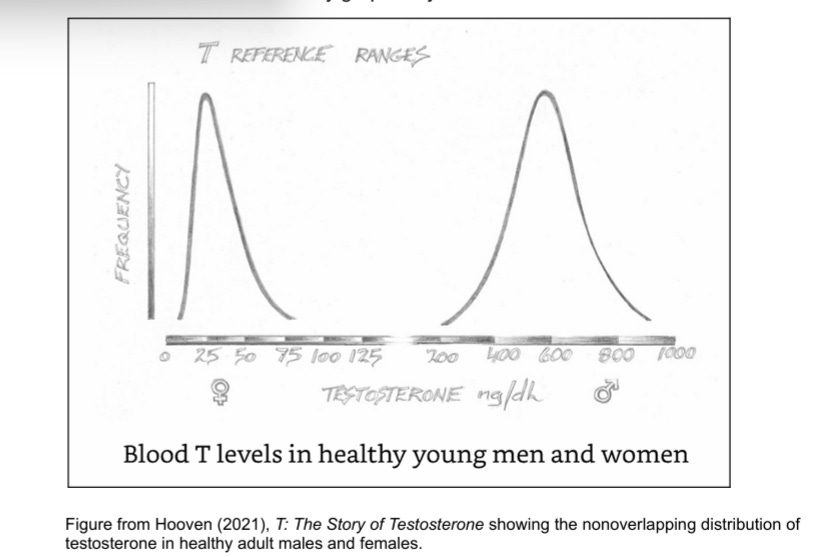
Carol Hooven wrote a groundbreaking book about testosterone that demonstrates the binary nature of mammalian reproduction. Sex spectrum advocates frequently claim that testosterone levels overlap between males and females. However, as this graph clearly illustrates, reference ranges of testosterone levels in healthy young adults show no overlap at all; they are binary.
Intersex people are as common as people with red hair
No, they are not. For starters, the term “intersex” is very outdated and unclear and appears to be mainly used by those who advocate the belief that there are more than two sexes or that one can indeed have no sex at all (nonbinary). The correct medical term is that some people are born with a Difference/Disorder of Sexual Development (DSD). It is important to note that this is a congenital condition that very few people are born with and has nothing to do with transgenderism, which is a choice or a belief. You can opt in to identifying as trans, but you cannot opt out of having a DSD.
The academic responsible for promoting the view that the frequency of being born with a DSD is a magnitude greater than reality is Anne Fausto-Sterling, who in 2000 was the lead author of a paper claiming that the rate of “intersex” births was at least 2% of the population.
This figure has been cited as gospel ever since, even though even a cursory examination shows why it is totally wrong. An early critique found that:
Blackless et al. (2000, chief researcher, Anne Fausto-Sterling) suggest that as many as 1.728% of live births are sexually nondimorphic. In this letter, I will outline several errors and oversights in that article and propose that their estimate is incorrect by an order of magnitude”, and concludes “the numerous errors and omissions made by Blackless et al. suggest that they were too keen to find a relatively high incidence of sexual nondimorphism.
Consensus statements on the frequency of being born with a DSD is 0.018% of all births, which is a long way off 1.7%, 2% or any other percentage that is carelessly thrown about. Given that not every DSD presents as ambiguous genitalia at birth, most medical practitioners will go through their entire careers and not meet even one person who is living with a DSD.
And finally, as this author stated:
[T]he existence of intersex people goes a long way towards confirming sexual dimorphism. After all, the prefix inter- means between or across. Intersex, broken down, would translate to between or across sexes. It’s hard to understand how this could be a meaningful concept without the existence of two discreet, recognizable things to be between or across. What could intersex mean if there weren’t two sexes as a point of reference? How could we understand international without the concept of distinct nations?
There is no reliable definition of sex
Biology defines sex by reproductive function, and this is reinforced by reality. Names are but labels, but our embodied reality counts for more. Can you go to any fertility clinic anywhere in the world and select your own baby-making gametes and gestational “vessel”? No, you cannot. Every fertility specialist knows that if you want to create a new human being, you need three basic elements that cannot be altered: an egg from a natal female, a sperm from a natal male, and a primed uterus in a natal female for around 40 weeks.
Culturally constructed gender roles may or may not have anything to do with sex, but biology/physiology is only interested in function, not appearance. And not just in current functioning, but in potential or previous functioning, so that prepubertal girls and boys and postmenopausal women are still sexed beings. Those involved in forensic work do not need to see genitalia to determine the sex of a corpse because any cell that contains usable DNA is sexed.
People who can’t see anymore are blind, not “eyeless”.
Male and female are “assigned at birth”
Spotted hyenas, porcupines, and guinea pigs are three species of mammals that are very difficult to sex at birth; not every mammal makes it easy for observers to know straightaway who are girls and who are boys. Fortunately for those vested with the responsibility of observing and recording the sex of human babies, it is immediately apparent which sex a baby is. In fact, it is so easy that no special training is required, and I am betting that every adult who has ever changed a diaper/nappy knows the difference at a glance.
Now that most women have several scans during their pregnancies, most parents know whether to stock up on pink or blue baby gear well before the big reveal of birth.
Determining a baby’s sex is not a social convention; we also do not “assign” a baby’s blood type.
Brain scans prove “female brains in male bodies” or “male brains in female bodies”
The neuroimaging literature does not support this opinion, and constant repetition does not make any belief true.
According to this source:
Dump the “dimorphism”: Comprehensive synthesis of human brain studies reveals few male-female differences beyond size.
With the explosion of neuroimaging, differences between male and female brains have been exhaustively analyzed. Here we synthesize three decades of human MRI and postmortem data, emphasizing meta-analyses and other large studies, which collectively reveal few reliable sex/gender differences and a history of unreplicated claims. Males’ brains are larger than females’ from birth, stabilizing around 11% in adults. This size difference accounts for other reproducible findings: higher white/gray matter ratio, intra- versus interhemispheric connectivity, and regional cortical and subcortical volumes in males. But when structural and lateralization differences are present independent of size, sex/gender explains only about 1% of total variance. Connectome differences and multivariate sex/gender prediction are largely based on brain size, and perform poorly across diverse populations. Task-based fMRI has especially failed to find reproducible activation differences between men and women in verbal, spatial or emotion processing due to high rates of false discovery. Overall, male/female brain differences appear trivial and population-specific. The human brain is not “sexually dimorphic.”
You won’t find an alpaca’s brain in a sheep’s body either, even if they are in the same herd.

Drugs and surgeries can change your sex
No, they can’t. Cosmetic surgery can alter appearance, create illusions, and satisfy (or not) the customer, but mammals are unable to change sex.
The ignorance around this is frighteningly high. David Lammy, a British MP and father of four, stated on an English news channel that, “I understand that a cervix is something you can have after various procedures, hormone treatment, all the rest of it” if you are a “woman” who was born with man parts, not lady parts. Sir Keir Stamer believed that “99.9% of women haven’t got a penis”.
Altering appearance and some secondary sex characteristics through medical interventions that include surgeries and hormones is cosmetic and does not change anyone’s sex. I wrote about this here:

“Gender identity” is genetic
In the same way that some have been occupied for decades fruitlessly searching for that elusive “gay gene,” now the hunt is on for the genetic causes for those poor souls whose “gender identity” is a mismatch with their bodies and biology.
If only it were that easy….
Mendelian genetics is great for working out simple traits, like eye color, but it is inadequate when dealing with complex issues that also have a large environmental factor influencing development. Socially mediated factors such as education and income can also push epigenetically mediated traits to the forefront of actualized phenotypic presentation, or these can remain hidden for the entire life course.
It may be just as useful to stick with the “gender angels” that some believe in; to believe that we all have some sort of amorphous presence that sometimes gets it wrong is surely no worse than believing we are genetically programmed to be “born in the wrong body”.
Sorry to break it to you, but there are only two sexes and it’s not complicated, really, it’s not
Reductio ad absurdum (Latin for “reduction to absurdity”) is a logical technique that disproves an argument by taking its premise to its logical extreme and showing that it results in a ridiculous, impossible, or contradictory conclusion.
Creating a new specialist field of “gender medicine” and promoting a muddled diagnosis of “gender dysphoria” is a denial of our essential humanity. Downplaying the profound nature of sex, which influences everything we are and ever can be, is destructive and produces chaos, not harmony.
The insertion of the medical model into areas of social crisis serves to create unthinking passivity in swathes of the population and works in tandem with the financial and political ambitions that are afoot to create dissociation between bodies and minds. These forces pave the way, as intended, for destructiveness in the social fabric. As a model it is reductionist in nature through its widespread misuse of language within the health services, and new diagnostic labels that are meaningless when put under scrutiny, all the while being promoted in parliaments as an authoritative lens on what is happening on a grand scale to the bodies and minds of children.
Sorry, gender woo people, but the more you go on, the more absurd you appear to be.
Lucy, another great article. I very much appreciate the clarity you provide on this controversial topic. I must share my favourite line, which is not only scientifically correct but also hilarious because of your emphasis on clarity:
"Mammalian sex, the purpose of which is reproduction, has been designed through millions of years of evolution to operate as a binary, which is two."
You always say it best. Thank you for your voice!
...and there we have it in a nutshell or, should I say paragraph????
[T]he existence of intersex people goes a long way towards confirming sexual dimorphism. After all, the prefix inter- means between or across. Intersex, broken down, would translate to between or across sexes. It’s hard to understand how this could be a meaningful concept without the existence of two discreet, recognizable things to be between or across. What could intersex mean if there weren’t two sexes as a point of reference? How could we understand international without the concept of distinct nations?